Static systems against non-deterministic ones
Six Sigma assumes a process behaves the same way twice. Agents do not. The control philosophy that worked on stable processes does not translate to a system that reasons.
Where optimisation ends and reinvention begins. For decades Six Sigma and Lean perfected the process. Agentic systems change the unit of optimisation from the process to the decision, and everything downstream of that has to be re-examined.
Take the calibrated assessment → See the shift →
Six Sigma was the right answer to the question of its time. It optimised processes, reduced variation, improved efficiency and built a generation of operating leaders through disciplined continuous improvement. None of that is being discarded here. The discipline of DMAIC is precisely what makes an agentic sense, think, decide, act and learn loop possible at enterprise scale, which is why each Six Sigma level is treated as a prerequisite rather than a casualty.
What has changed is what you are optimising. A process can be brought under control. A decision made by a system that reasons cannot be controlled in the same way, and the moment that becomes the unit of work, the control philosophy, the metrics, the roles and the governance all have to be rebuilt on different foundations.
Lean made you efficient. Six Sigma made you reliable. The Seventh Sigma makes you different.
A side-by-side reframe of what changes when the system itself becomes intelligent.
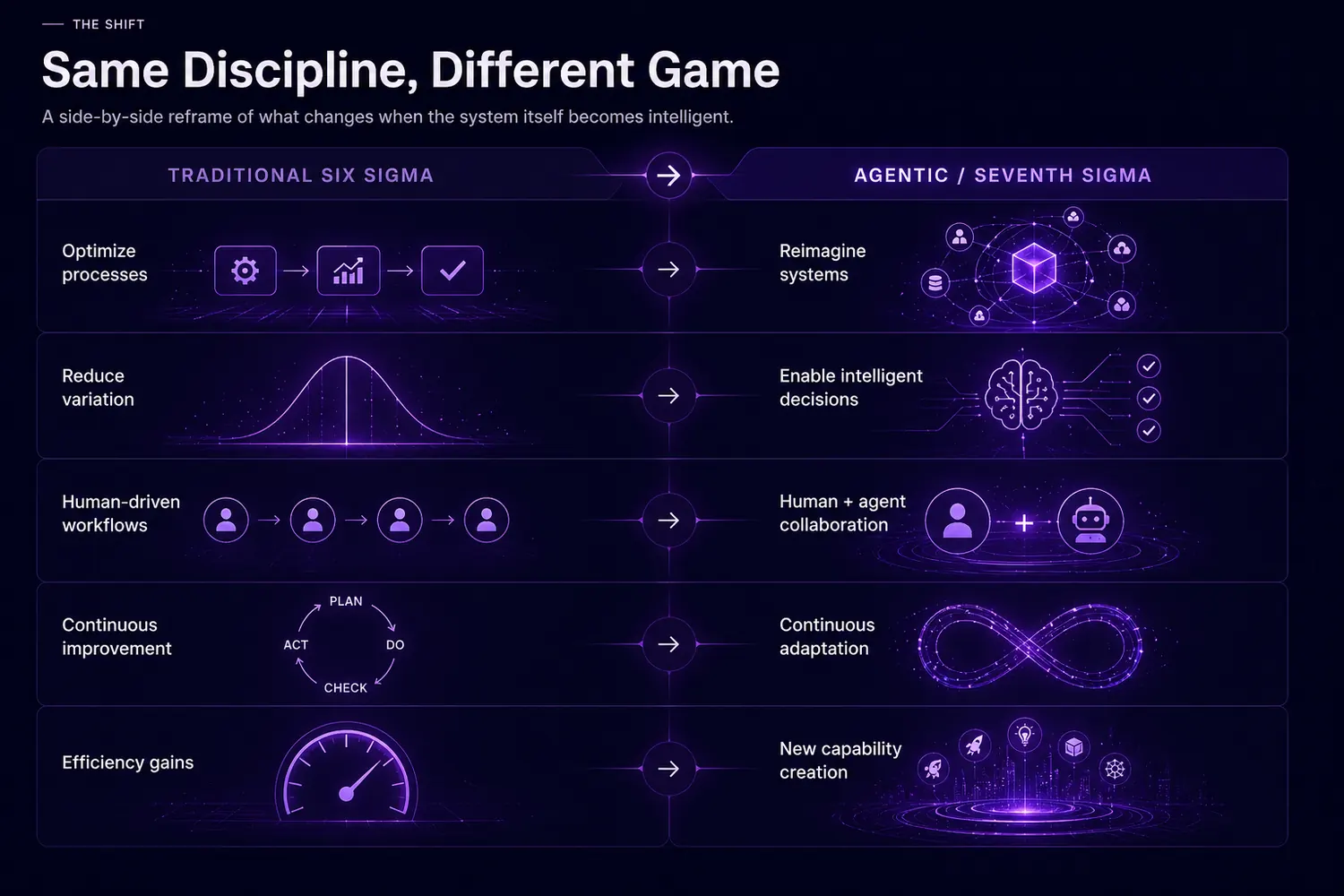
The discipline still applies. The assumptions do not. These are the five fault lines you meet first.
Six Sigma assumes a process behaves the same way twice. Agents do not. The control philosophy that worked on stable processes does not translate to a system that reasons.
Standardisation made variation the enemy. With agents, the right variation is where the value comes from. The discipline has to learn when to lock and when to let go.
You are no longer monitoring an output distribution. You are closing a loop on autonomous behaviour. A different signal, a different intervention and a different governance model.
Detection used to trigger a person. Now it triggers an agent. The operator moves from acting to supervising the system that acts.
The most expensive mistake is optimising a workflow that should have been redesigned. Telling the difference before spending the cycle is the skill the track exists to teach.
A concrete sequence for organisations rooted in Six Sigma, Lean and operational-excellence cultures.
Static against non-deterministic systems. Process rigidity against adaptive intelligence.
From control charts to control loops. From monitoring to autonomous action.
Agents as decision-makers. People as supervisors and exception handlers.
Black belts become agent stewards. Governance shifts. KPIs are redesigned.
Where not to optimise, and where to redesign the underlying system entirely.
The discipline does not disappear. It transforms, and the people it built are the ones who carry it forward.
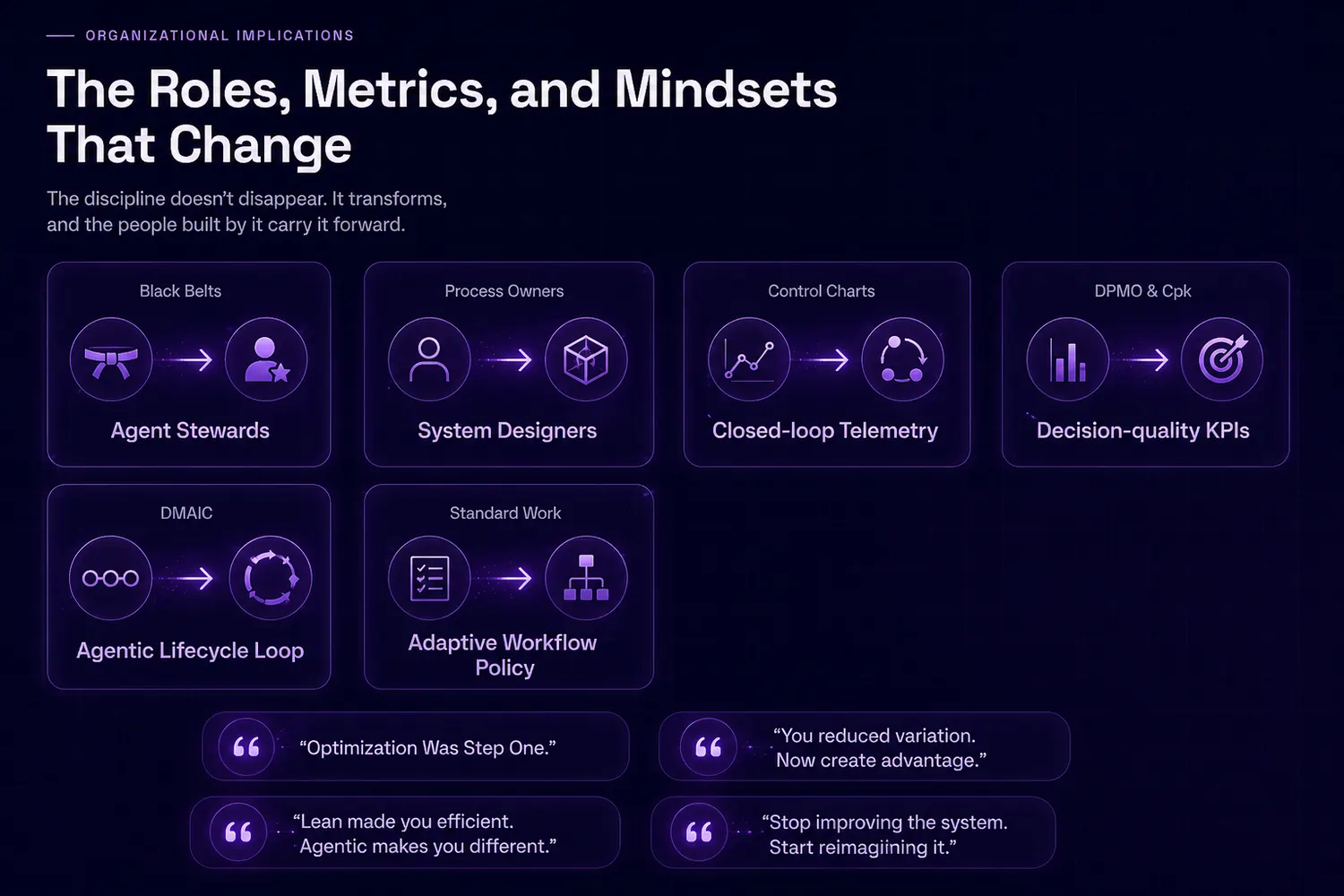
The Seventh Sigma extends operational excellence past its limits rather than invalidating it. The career, the discipline and the operating muscle all still matter. What is on offer is the next evolution, not an erasure of what came before.
The readiness assessment is calibrated for operational-excellence cultures and routes qualified leaders into this track. It takes about a minute.
Take the assessment → Back to the 360° model →