
Reduce the cost and risk of trying
When several operators face the same problem, none should pay for the first attempt alone. Shared research and shared failure is the economic argument for a consortium and the reason members join.
Empowering cross-sector innovation through AI for a sustainable industrial future.
Association Partner — Energy Conference Network The council has held a place on Energy Conference Network's oil, gas and energy digitalisation programmes since 2021, as a listed partner and through consortium speakers on panels in Houston, Calgary and Appalachia. It is where the council's work reaches the operators it is built for. Inside the partnership →
The council brings academia, industry leaders and technology partners together to apply artificial intelligence to the most difficult problems in oil and gas, chemicals and utilities.
We run this as a place for open innovation, applied research and strategic collaboration, and the point of it is to shorten the distance between a promising idea and something an operator will actually run. Members bring problems from their own operations, and the work is scoped against those problems rather than against what happens to be interesting in the literature.
The reason companies join is economic before it is technical. When several operators face the same problem, none of them has to pay for the first attempt by themselves, and each of them gets to learn from failures that happened somewhere other than their own plant. That is a straightforward reduction in the cost and the risk of trying something new.
The council is a standing body working across research, safety, workforce and policy in oil and gas, chemicals and utilities. The four pillars below are where that work is organised.
When several operators face the same problem, none should pay for the first attempt alone. Shared research and shared failure is the economic argument for a consortium and the reason members join.
Most industrial AI stalls between a promising result and a system a control room will run unattended. The council works on data readiness, failure modes and accountability, which is the unglamorous part that decides whether anything ships.
The lab model exists so students and commercial partners work on live proof of concept projects together, and so research is steered by problems operators actually have rather than by academic curiosity.
Health, safety and environment is what operators rank first, and it is where the council concentrates. Systems that reduce how often somebody has to be somewhere dangerous are the clearest return this technology offers.
Incubator placements, credential pathways and training that survives contact with a plant. A model nobody on shift can interrogate does not get used, whatever its accuracy.
Turning operational evidence into guidance for regulators and legislators, and mapping it against federal energy, infrastructure and competitiveness programmes so that the work has a route to funding.
Each pillar is a standing area of research. Each one has live work attached, and every programme below began as a use case proposal from a member.
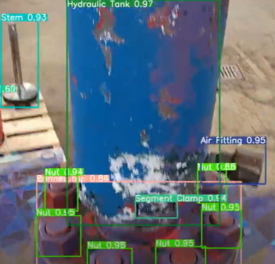
AI that improves asset integrity, reduces operational risk, and supports environmental and social governance goals.
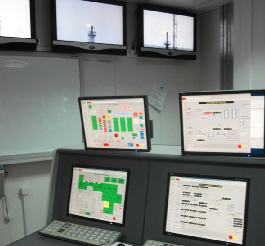
Efficiency, yield improvement and energy optimization through intelligent, data-driven process enhancement.
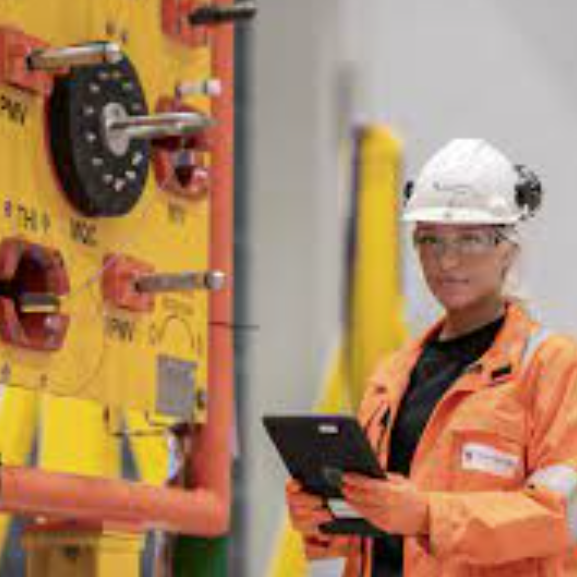
Better safety outcomes and worker productivity, with AI tools and insights that empower a future-ready workforce.
The digital and organizational foundations — data architecture, governance, platforms and skills — that scalable AI adoption actually requires.
A member brings a problem from their own operation, the working group scopes it against three questions, and the answers determine whether it becomes funded work.
What is the problem, why do current methods fall short, and what would a better approach change? Prior art cited, not assumed.
What data is needed and where it comes from — including synthetic, published or obfuscated data where commercial data cannot be shared. What compute it takes. Which university partner brings the research depth.
What good looks like, written down before the work starts. Working prototypes, named benchmarks to beat, and a published strategy others can reuse.
Combining machine learning with physics and chemistry models to beat what either achieves alone — in speed and in accuracy.
Multiphysics models built for study work, such as computational fluid dynamics, can be transformed to run on demand or as agents monitoring thermal stress and particle deposition. Models built on chemical kinetics, thermodynamics or physical property estimation can be made to represent commercial assets far more precisely once integrated with ML — which matters most exactly where unaccounted-for factors drive error today, in catalyst activity calculations and heat exchanger performance monitoring.
Neural network structures incorporating exponential terms are also emerging for better prediction of system dynamics. Experimentation is what matures these technologies into something deployable against high-value use cases.
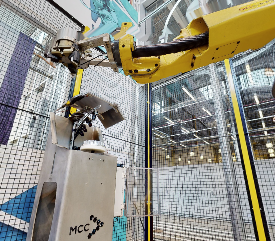
At the University of Houston at Sugar Land, inside the College of Technology's Advanced Technology and Innovation Laboratory.
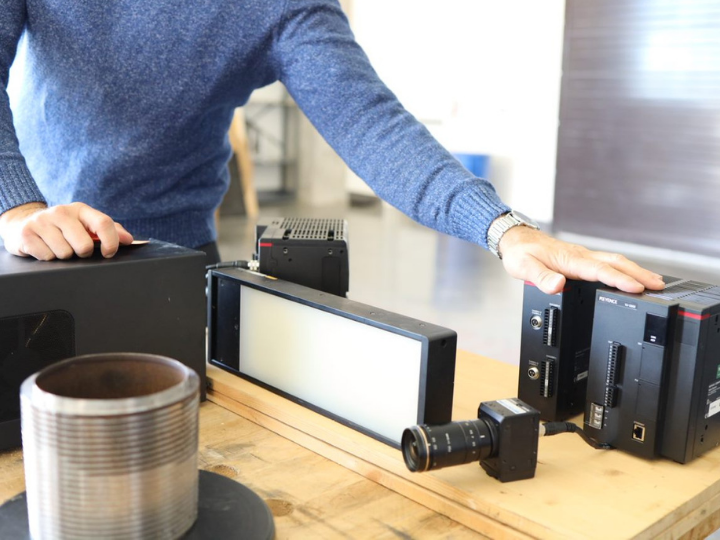
The lab's purpose is narrow and physical. It uses machine learning to promote safety and efficiency by reducing how often a person has to be somewhere dangerous simply to find out what is happening there.
Its work runs along three lines — predictive analytics, AI visual inspection, and health and safety. It is built as an incubator, so students work with commercial partners on live proof-of-concept projects rather than exercises with known answers.

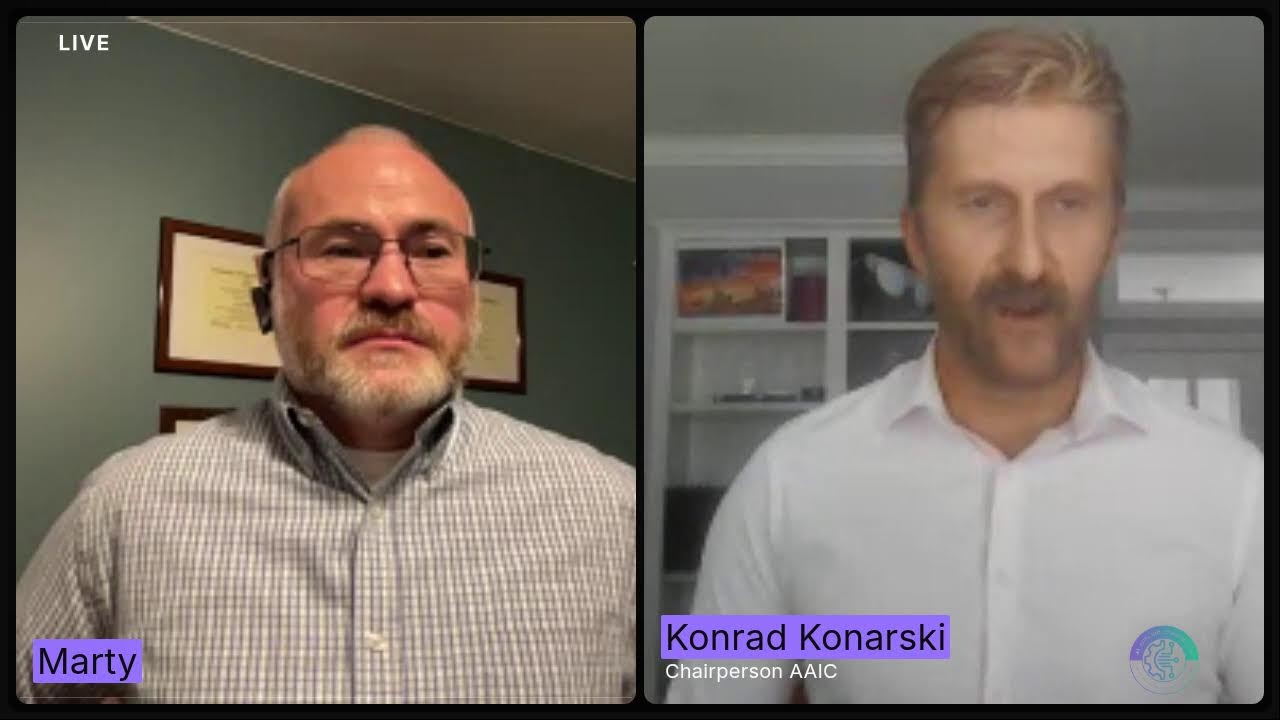
Dr. Martin Gonzalez, Director of Innovation at bp — with Konrad Konarski, Chairperson.

Dr. Satyam Priyadarshy, former Chief Data Scientist at Halliburton — with Konrad Konarski.
Operators, refiners, chemical producers, service companies, universities and industry bodies, represented on the council or partnered on its programmes.
 Operator
 Operator
 Chemicals
 Energy services
 Energy services
 Drilling
 Refining
 Refining
 Specialty chemicals
 Technology · XR Network
 Association partner
 Technology
Operators, refiners, drilling contractors, chemical producers and academics. Everyone here has had to live with the consequences of an AI decision inside a plant or a field.

Senior Manager, Refining Technology · Trustee

Senior Principal AI Architect & ML Engineer

Senior Director, Operations Technology & Advanced Process Controls

Senior Director, IT & AI Center of Excellence

Senior Vice President, Innovation, Digital & Business Transformation (Retired)

Forward Deployed Engineer & AI Divisional Lead

Director of Process Safety

Former Chief Data Scientist · Trustee
Manager, Learning Solutions

Market Leader, IoT & AI

Global Manager, Analytics

Director, Digitalization of Production & Technology (Ret.)
Membership is aimed at people who are accountable for what AI does inside an energy business rather than people watching the field from outside it. If you run a production, safety, data or digital function at an operator, a chemical producer, a service company or a utility, you will find peers here working on the same problems.
Members join quarterly working sessions and one annual symposium, and take part in the council's research and policy work. In practice this comes to about a day each quarter.
You get access to peers working the same problems, early sight of what the lab is producing, and a place at the table when the sector's policy position is written.
We ask members to be honest about the things that did not work. The council is only useful because people describe their failed pilots accurately.
Most council seats are filled by nomination. For the seats open by application, contribution details are shared directly with each applicant. Anyone can join the wider network for $99 a month.