Energy services
The scarcest resource in heavy industry is not equipment, it is expertise. The Connected Worker Lab combines AI with mixed and virtual reality so that the expert can be wherever the problem is, without getting on a plane.
The model A consortium lab that grew out of the Oil & Gas Connected Workers programme, where industry leaders, technology innovators and academic pioneers develop connected-worker solutions with safety as the first requirement and productivity as the consequence.
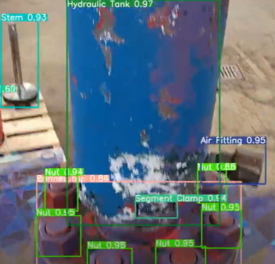
Mixed reality earns its place in heavy industry for one reason: a specialist can see what a technician sees on a platform offshore, mark up the view, and be gone in ten minutes rather than on a flight in two days.
The lab combines AI with mixed and virtual reality to blend the physical and digital worlds around the frontline worker. The AI decides what deserves attention; the headset decides how a person experiences it. Neither is useful alone, and the lab treats them as one discipline rather than two.
Every solution is judged by a field standard, not a demo standard: does it work in gloves, in glare, on a network that drops, for a workforce that did not sign up to be beta testers.
See-what-I-see collaboration between field technicians and remote specialists, with AI surfacing the readings and anomalies worth a specialist’s time.
Virtual environments where a worker can rehearse the dangerous procedure before the day it is real — and where the AI measures readiness instead of attendance.
Connected-worker sensing that detects hazardous conditions and unsafe configurations around a person in time to act, extending the consortium’s health-and-safety research to the individual worker.
The programme’s founding commitment is a holistic approach to connected-worker solutions — benefits that reach the whole workforce rather than a single pilot team with executive attention.
Learning-solutions practitioners from the consortium’s industry partners shape the training work; operators shape the field work. The consortium also partners with the connected-worker ecosystem beyond its own walls, including the Connected Worker: Manufacturing Summit, where its leadership has spoken on what the connected workforce actually requires.
The lab draws on the Energy & Utilities Council and the consortium’s extended-reality partners.
Energy services
Technology · XR NetworkThe lab’s extended-reality research connects directly to the XR Network — the industrial-metaverse initiative with NVIDIA and TechnipFMC that grew from the Digital Oilfield Lab.
The two efforts share people, partners and a thesis: digital twins and mixed reality are worth exactly as much as the field problems they remove.
Partners bring the problem and the data. Students and faculty bring the build. The consortium sets the terms so both sides know where the work goes.
Bring a field task that currently requires travel, escort or scaffolding. You supply the task and the constraints; the lab supplies the build.
Join extended-reality and connected-worker projects with the consortium’s energy partners.
Bring hardware or platforms that survive the field standard, and put them on real tasks with real operators.