AI Applied Consortium
Labs  /  Digital Oilfield Lab
AI Industry Incubator

Digital Oilfield Lab

The energy industry is becoming more dependent on data and artificial intelligence every year. The Digital Oilfield Lab exists so that students, faculty and industry professionals can build the technologies that dependence requires — in one place, on real problems.

Sugar Land, TexasLocation
University partner networkHost
Advanced Technology & Innovation LaboratoryWithin
Energy & UtilitiesCouncil

The model A joint facility of the AI Applied Consortium and its university partner network, operating inside a dedicated advanced technology and innovation laboratory in Sugar Land, Texas. Students, faculty and industry engineers share the same floor and the same problems.

The brief

Minimise human presence in the field

The energy industry is becoming more dependent on data and artificial intelligence every year. The Digital Oilfield Lab exists so that students, faculty and industry professionals can build the technologies that dependence requires — in one place, on real problems.

The lab's founding purpose is deliberately narrow and deliberately physical: use machine learning to promote safety and efficiency by reducing how often a person has to be somewhere dangerous to find out what is happening there.

That framing does more work than it appears to. It rules out the analytics dashboard that tells an operator something they already know. It rules out the model that cannot be trusted without a human standing next to it. What is left is the harder and more useful category — systems that genuinely substitute for presence.

Digital Oilfield Lab
Research focus

What the lab works on

01

Predictive analytics

Anticipating equipment and process failure from sensor data before it becomes an incident, a shutdown or a repair crew in the field.

02

AI visual inspection

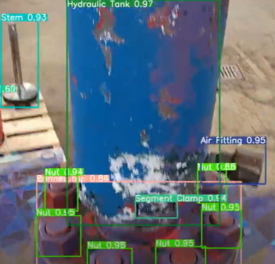
Computer vision applied to inspection tasks that currently require someone to climb, enter or approach — reading condition from imagery instead of proximity.

03

Health and safety

The application operators consistently rank first. Detecting hazardous conditions and unsafe configurations in time to act on them.

How it works
Students in the lab

Students working on live industry projects

The lab is structured so students contribute to live applied research and proof-of-concept work alongside the consortium's commercial partners, rather than classroom exercises with known answers.

The intent is a path, not an experience. A student joins a real project with a real partner, does work that matters to that partner, and finishes with a portfolio and a set of relationships inside the operations that participated. Several have moved directly from the incubator into jobs at those companies.

For the industry side, the arrangement solves a problem money alone does not: access to people who have already worked on the specific class of problem, and who arrive knowing what the equipment does.

This incubator programme is grounded in clear business value — technologically rich, hands-on, and built on a genuine industry and academia partnership. Konrad Konarski — Chairperson, AI Applied Consortium
On the record

Why the partners built it

“These types of AI programmes help strengthen efforts for broader industry adoption, and are cultivating the next generation of AI experts in the workforce.”Kris SkrinakGlobal Machine Learning Segment Lead, Amazon Web Services

The people

Lab leadership

Kris SkrinakGlobal ML Segment Lead, Amazon Web Services · Advisory Council
Konrad KonarskiChairperson, AI Applied Consortium
Academic network

The lab sits inside a wider university network contributing to the consortium's applied research.

Penn StateResearch university
University of LouisvilleUniversity
University of KentuckyResearch university
What came next

XR Network

The lab's foundation carried into extended reality and digital twins for oilfield services, with NVIDIA and TechnipFMC.

Mixed reality earns its place in energy for one reason: it puts expertise where the expert is not. A specialist in Houston sees what a technician sees on a platform offshore, marks up the view, and is gone in ten minutes rather than on a flight in two days.

Marc SpielerGlobal Energy Director, NVIDIA
Adam BergManager, Learning Solutions, TechnipFMC
William AikenTrustee, AI Applied Consortium
Extended reality in the field
Get involved

Work with the lab

Operators bring the problem and the data. Students and faculty bring the build. The consortium sets the terms so both sides know where the work goes.

For operators

Propose a proof of concept. You supply the use case, the data and a technical contact; the lab supplies the team.

For students

Join a live project with a commercial partner. Applications run through the consortium's partner universities.

For universities

Join the academic network and put your researchers on industry problems with data attached.

Start a conversation →   Energy & Utilities Council →