
Governance and ownership
Who is accountable for a system once it is live, named rather than assumed.
A formal partnership since April 2025. It has produced a joint advisory council, a university-hosted executive symposium and a governance framework now circulating in the $8.7 trillion distribution sector.
Strategic partner since April 2025 Founded in 1946, NAW is the national voice of wholesale distribution: roughly 35,000 employers, close to six million employees, and something in the order of eight trillion dollars of annual economic activity. It runs the NAW Institute for Distribution Excellence, the industry's research and executive education arm. naw.org →
Wholesale distribution sits between manufacturers and everyone who buys from them. When it adopts a technology slowly, the delay is felt in every sector downstream of it.
NAW and the consortium announced the partnership on 7 April 2025. The stated purpose was to accelerate applied AI adoption across distribution through joint research, a standing advisory council and cross-sector work, and the reason it was needed is that distributors were largely solving the same problems in private, at their own expense, without any way of comparing notes.
The centrepiece is the Wholesale and Distribution Advisory Council, which NAW leads inside the consortium. Its scope was set at the start: supply chain management, inventory optimisation, workforce productivity and customer intelligence. Those are the four places where a distributor's margin is actually made, which is why the council was pointed at them rather than at general questions about the technology.
What the arrangement gives each side is straightforward. NAW brings the industry, its members and its convening power. The consortium brings people who have already put these systems into production in energy, manufacturing and financial services and can say which parts were harder than expected. The work that comes out of it is published rather than sold.
“Distributors are uniquely positioned to unlock massive value from applied AI, from forecasting and fulfillment to customer engagement.”
Bart Tessel · Chief Innovation Officer, NAW
“Partnering with NAW allows us to bring the power of applied AI to the front lines of supply chains.”
Konrad Konarski · Chairperson, AI Applied Consortium
“AI is revolutionizing how we operate, compete, and serve customers.”
Teesee Murray · Group President, Turtle · Trustee
Sixteen months, four things that exist in public and can be checked.
The Wholesale and Distribution Advisory Council is formed, led by NAW within the consortium's council structure, with a membership drawn from across the distribution ecosystem and a remit to develop real use cases rather than position papers.
The first public programme under the partnership. Consortium leadership on the platform in front of distribution executives, which is a different audience from the one that reads a governance document and a necessary one to reach first.
A full day, closed room, co-hosted with the NAW Institute for Distribution Excellence and the Thomas and Joan Read Center at Texas A&M, with InstaLILY AI and SAP Americas as presenting sponsors. Explicitly the first in a recurring series. Detailed below.
A governance framework for distributors putting AI into operations, written for an industry where most companies do not have a legal or compliance function to hand the problem to. Detailed below.
Twelve speakers presented across the day, and the findings were not what most of the industry expected.
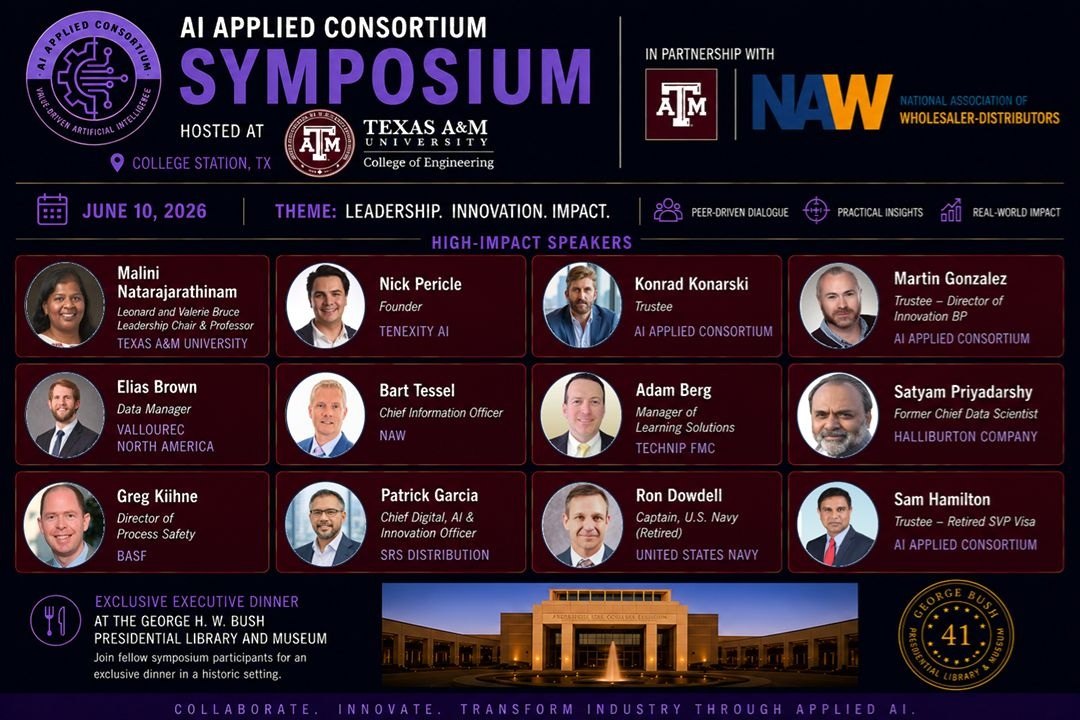
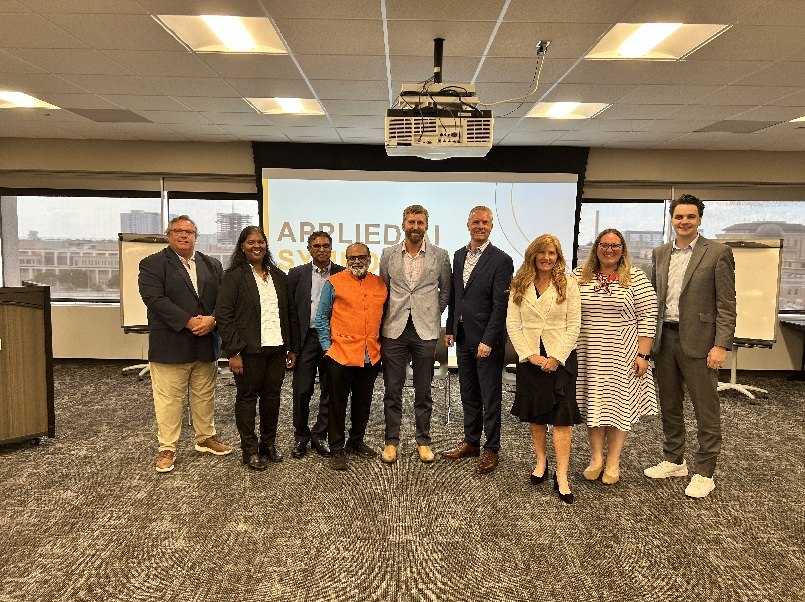
The symposium was built as a peer-to-peer forum rather than a conference. Attendance was by invitation, the sessions were closed, and the day ended with a dinner at the George H. W. Bush Presidential Library and Museum. The theme given to the speakers was leadership, innovation and impact, and the working question was what it takes to move AI out of pilots and into an operation at company scale.
The headline finding was organisational. Distributors reported that the primary barrier to adoption is not data quality and not the technology. It is resistance in the middle layer of management, and the fact that most of the institutional knowledge an AI system would need has never been written down anywhere. That reframes the problem from a procurement exercise into a change problem, which is a harder thing to buy your way out of.
The second finding cut against the assumption that adoption means job losses. Where these systems went in, the effect reported was upskilling. One executive described rolling an AI sales platform across an entire sales organisation in four months without reducing headcount. Several described hiring differently as a result, for curiosity and learning agility ahead of credentials.
The gap this produces is measurable. Distributors deploying AI are pulling ahead of those that are not, in an industry of roughly eight point seven trillion dollars where a performance gap of that kind compounds quickly.
“Distribution industry leaders are not waiting around for AI to be figured out somewhere else.”
Bart Tessel · Chief Innovation Officer, NAW
“The distribution industry is hungry for AI strategies and solutions that can enhance day-to-day operational efficiency.”
Malini Natarajarathinam, PhD · Texas A&M University
“The line between technical and business roles is collapsing.”
David Wascom · Industry Executive Advisor, Wholesale Distribution, SAP Americas
Published 21 July 2026 by NAW and the consortium. A practical governance model for distributors, written on the assumption that most of them do not have a compliance department.
The framework is organised around five areas: governance and ownership, risk management and classification, transparency and documentation, workforce development, and responsible implementation. Its central mechanism is a risk tier. Low-risk applications carry light oversight. Applications that touch employment, safety, credit or customer outcomes carry documentation, testing and human review in proportion to what they can affect, which keeps the paperwork attached to the decisions that warrant it.
Two choices in it are worth naming. It recommends aligning with the NIST AI Risk Management Framework rather than inventing a private standard, so that a distributor's programme is legible to regulators and to its own customers. And it evaluates systems on outcomes that can be measured after the fact, which are accuracy, auditability, security and non-discrimination, rather than prescribing which technology to buy.
It was written for the size of company that actually makes up the industry. Small and midsized distributors with limited IT, legal and compliance capacity are addressed directly, and the framework is designed to sit alongside the regulatory obligations that already apply in pharmaceutical, food, chemical and defence supply chains instead of duplicating them. Contributing authors include the consortium's Chairperson and Nick Pericle of the NAW Institute.
Who is accountable for a system once it is live, named rather than assumed.
A tier per application, so oversight scales with what the system can affect.
A record of what the system does, on what data, and how it was tested.
The training and role changes adoption actually requires, treated as part of the deployment.
Human review where the decision warrants it, and measurable outcomes after go-live.
The partnership and its output have been covered by the distribution and supply chain trade press since 2025.
Covered the partnership at announcement, and again in July 2026 with the most detailed account of the governance framework's risk tiers and its NIST alignment.
Read →Framed the framework around its central commitment, which is strengthening workers with AI rather than replacing them.
Read →Reported the governance architecture alongside the accompanying policy position on federal standards for AI in supply chains.
Read →Covered the formation of the partnership and the advisory council in April 2025.
Read →The partnership is run by people with distribution operating experience, not by a communications function.

Chairperson · Contributing author, AI Governance Architecture
Group President · Trustee

Trustee · Symposium speaker
On the NAW side the partnership is led by Bart Tessel, NAW's Chief Innovation Officer, with Nick Pericle of the NAW Institute for Distribution Excellence acting as the bridge into the council's working membership.
The council's membership is distributors, and its output is only as good as the operating detail its members are willing to share. The next symposium is already planned, and the governance framework is a working document rather than a finished one.
The Wholesale & Distribution Council → The original announcement →